Showing posts with label Neyshaboor. Show all posts
Showing posts with label Neyshaboor. Show all posts
Saturday, February 28, 2009
Neyshaboor
History
Nishapur occupies an important strategic position astride the old Silk Road that linked Anatolia and the Mediterranean with China. On the Silk Road, Nishapur has often defined the flexible frontier between the Iranian plateau and Central Asia. The town derived its name from its reputed founder, the Sassanian king Shapur I, who is said to have established it in the 3rd century CE. Nearby are the turquoise mines that supplied the world with turquoise for at least two millennia. It became an important town in the Khorasan region but subsequently declined in significance until a revival in its fortunes in 9th century under the Tahirid dynasty, when the glazed ceramics of Nishapur formed an important item of trade to the west. For a time Nishapur rivaled Baghdad or Cairo: Toghrül, the first ruler of the Seljuk dynasty, made Nishapur his residence in 1037 and proclaimed himself sultan there, but it declined thereafter, as Seljuk fortunes were concentrated in the west. In the year 1000CE, it was among the 10 largest cities on earth [2]. After the husband of Genghis Khan's daughter was killed at Nishapur in 1221, she ordered the death of all in the city (~1.7 million), and the skulls of men, women, and children were piled in pyramids by the Mongols. This invasion and earthquakes destroyed the pottery kilns. In 1979, the 15th World Scout Jamboree was scheduled to be held in Nishapur, but it was cancelled
Culture
Nishapur is also home to many poets and cultural celebrities. The poet Omar Khayyám was born in Nishapur in 1048 and is buried a few miles outside the town, near the Imamzadeh Mahroq Mosque. The 12th century poet and mystic Farid al-Din Attar, another native of Nishapur, is also buried nearby. And Iran's greatest contemporary painter, Kamal-ol-molk is buried in the same place. Also Nishapur has been the hometown of famous people including:
1. Muslim ibn al-Hajjaj (one of Islam's greatest muhaddiths, whose collection of hadith, Sahih Muslim, is second in authenticity only to Muhammad al-Bukhari's Sahih al-Bukhari)
2. Imam al-Hakim (another one of Islam's greatest muhaddiths and scholarly giants)
3. Prof. Mohammad Reza Shafiei-Kadkani (great contemporary Persian poet and writer and Persian literature Professor, who is famous for his literary criticism)
4. Ostad Parviz Meshkatian(famous Musician, researcher, Santur Player and composer).
5. Heydar Yaghma(an illiterate worker who began telling poems and published them.)
6. Hajji Bektash Wali(Muslim mystic, humanist and philosopher)
7. Wakil-i-Mutlaq , Burhan ul-Mulk, Itimad ud-Daula, Nawab Sayid Sa'adat Khan Bahadur, Shaukat Jang (Circa 1680-19 March 1739), better known as Saadat Khan or Burhan-ul-mulk, was the founder of the Awadh dynasty,UP, India.
Saadat Khan hailed from a noble Saiyid family from Nishapur in Khurasan. Born Mir Muhammad Amin, he entered the Mughal court as a camp superintendent but went on to obtain a mansab under Furrukhsiyar . He played an important role in the ascension of Muhammad Shah to the throne and overthrow of the Saiyid Brothers. He earned the title of Saadat Khan Bahadur in 1720 and was awarded the Governorship of Awadh as reward in 1722.
At the time, Lucknow was under the influence of a Muslim community, the Shaikhzadas. Saadat Khan settled the disturbed fortunes of his territory by military force, and established his court at Faizabad . He was summoned to Delhi by Nadir Shah , and died there in 1739.
Archaeology sites
Little archaeology has been done on this vast and complicated site. George Curzon remarked that Nishapur had been destroyed and rebuilt more times than any other city in history, an evocative statement whether or not it is statistically true. The Metropolitan Museum of Art undertook excavations from 1935 that were interrupted in 1940. Searching largely for museum-worthy trophies that they shared with the government of the Shah, the Metropolitan's publications were limited to its own Nishapur ceramics. The site of Nishapur has been ransacked for half a century since World War II, to feed the international market demand for early Islamic works of art.
Archaeology sites
Bowl with white slip, incised design, colored, and glazed. Excavated at Sabz Pushan, Neishapur. 9th-early 10th century. New York Metropolitan Museum of Art.
Little archaeology has been done on this vast and complicated site. George Curzon remarked that Nishapur had been destroyed and rebuilt more times than any other city in history, an evocative statement whether or not it is statistically true. The Metropolitan Museum of Art undertook excavations from 1935 that were interrupted in 1940. Searching largely for museum-worthy trophies that they shared with the government of the Shah, the Metropolitan's publications were limited to its own Nishapur ceramics. The site of Nishapur has been ransacked for half a century since World War II, to feed the international market demand for early Islamic works of art.
Recent incidents
* In the Summer of 1987(24.7.1987), a flood in Boojan village killed over 1,000 people and destroyed some villages.
* On February 18, 2004, in the Nishapur train disaster, a train carrying flammable goods derailed and caught fire near the town. Five hours later, during fire fighting and rescue work, a massive explosion destroyed the train and many nearby buildings. Around 300 people were said to have been killed, mainly fire and rescue workers but also the local governor and mayor and the heads of the fire and rail services.
Souvenirs
The most important Neyshabur souvenirs include turquoise and rhubarb.
Neyshabur Turquoise has been used for more than 2000 years and for this turquoise it is sometimes called "the turquoise land". Neyshabur turquoise and jewellery made from it are sold as souvenirs in Neyshabur and Mashhad resorts.
Rhubarb, a sour fruit, grows at the foot of Mount Binalud. Soft drinks made from this fruit, such as "Sharbate rivaas" (in Persian:شربت ریواس) and "Khoshaabe rivaas" (in Persian:خوشاب ریواس), are sold at some Neyshabur resorts as souvenirs.

Neyshaboor
Neyshaboor - A Glance on the Cultural,
Historical and Touristic Attractions
Located north of Khorosan, Nayshabur covers an area of 9.248 square kilometers. |
 |
The History of Neyshaboor
| Located on the Silk-Road, Neyshaboor is one of the most ancient cities if Iran. It dates back to the Sassanid monarch, Shapur I. According to recent archaeological discoveries, Neyshaboor shared in trade with the valley of Indus river in Pakistan and the area of Mesopotamia in the 3rd millennium BC. Recently significant ancient sites, dating to the 3rd and 4th millennium BC, were discovered around the city. It seems that the most ancient evidence related to Neyshaboor is an inscription known as Ka´be-ye Zartosht (Ka´ba of Zoroaster). Dating in origin from the regin of Shapur I, it is also called Tamam Aparakhshtar. One of the most important pre-historical fire-temples, known as Azar-Barzin-Mehr, was located in Neyshaboor and dedicated to the farmers. It was formerly named Abarshahr, but from the Islamic period onwards its name changed into Neyshaboor. In the time of ´Abdollah ebn-e Taher, Neyshaboor served as a capitel and gradually grew in importance. After the fall of the Taherid dynasty, the Saffarids adopted it as a capitel. Under the Ghaznavids and Saffarids, It was brought to a peak and changed to the wealthiest and most populated Islamic areas. Soon after it razed to the ground, owing to the Mongol invasion. A new city was built on the north-western boundary of the old one shortly after, due to which the city flourished again. It was devastated by an earthquake in 808 AH. Neyshaboor rose to importance under the Timurid dynaty and grew in size and splendour, thanks to the efforts of the people who admire their culture and authorities who are conscious.
Remains of the ancient city of Neyshaboor Covering an area of about 2000 hectares, the remains of the ancient city of Neyshaboor is located on the south-eastern boundary of the present-day Neyshaboor. The area enjoys, ancient hills of Kohandezh, Alb-Arsalan, Sabz-pooshan, Shadiyakh, Tappeh Madraseh, Bazaar, Qanat Tappeh and Takestan. Its National Monuments Registration Number is 216.
Remains of the ancient city of Neyshaboor |


People in traditonal clothes in front of a city gate,
in the middle of the 19th century.
 |  |  |  | ||
 |  Scheich Farid Addin ATTAR |  Kamal-ol-Molk (one of the great Iranian artists 1847-1940) |  | ||
 |  |  |  | ||
| | Touristic Sites of Neyshaboor
Khayyam Museum
Plan von Neyshaboor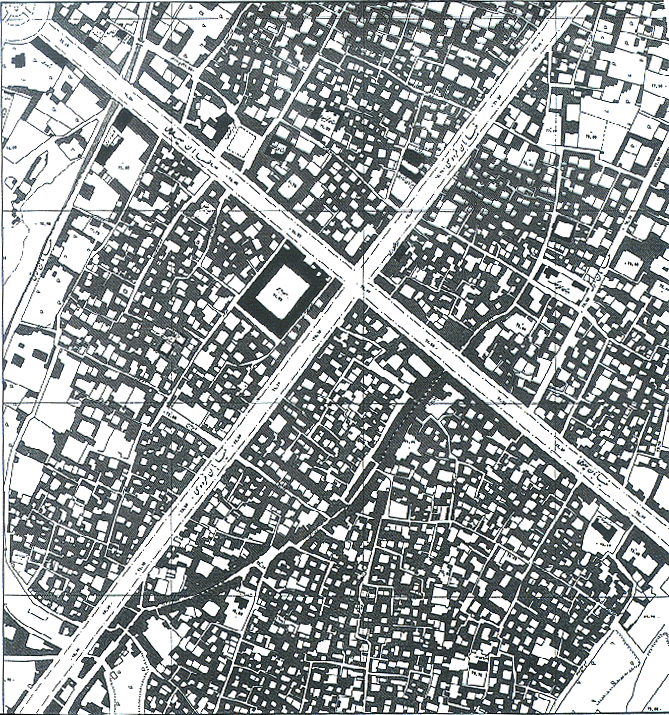 |


Subscribe to:
Posts (Atom)